Which Surfaces Are Unsuitable for Silicone Adhesive?
Silicone adhesives are essential for building and repairs. They create strong bonds on surfaces from glass and metal to ceramics and concrete. However, even a strong product has limitations. Using silicone without understanding them can waste time and lead to poor results.
Dusty, Dirty or Greasy Surfaces
Dust, dirt and grease can weaken silicone adhesion. Bonding should not be explained as exclusively mechanical or exclusively chemical. Oil, dust or residue can keep the silicone from making sufficient contact with the sound substrate. This matters particularly around kitchen worktop edges and areas where grease vapour builds up. Do not assume separation will occur within a few hours.
Industrial equipment can suffer similar problems. Oily metal reduces adhesion and can affect equipment performance. Clean surfaces are critical before applying silicone around oily engine blocks and gaskets.
Before applying silicone, choose a cleaning method compatible with the surface and product. Isopropyl alcohol, acetone and thinner are not suitable for every material or paint. Follow the product and surface manufacturer’s instructions and test a hidden area first. After cleaning, let the surface dry as required for application.
Damp or Underwater Surfaces
Cured silicone’s water resistance does not mean it can be applied to wet surfaces or underwater. A water film can affect surface contact and adhesion. Follow the surface-preparation instructions for bathroom joints, shower enclosures and exterior work. Products for marine applications and polyurethane sealants are not automatically suitable for underwater application either; this use must be explicitly stated in the selected product’s technical information.
General-purpose silicone is common in installation work, while acrylic sealant is generally preferred indoors. The application determines the type. Clear and white silicone, for example, allow appearance to influence the choice. Once dry, they provide a durable seal and work effectively for insulation and sealing.
For joints around tiles and baths, choose a product suited to the surfaces and sealing in wet areas. Marine products need not replace standard silicone in every case. Check the stated applications of silicones developed for kitchens and bathrooms. Meet the selected product’s surface-preparation, dryness and cleaning requirements.
Polyethylene (PE) and Polypropylene (PP)
Polyethylene (PE) and polypropylene (PP) are low-surface-energy plastics, which makes adhesion difficult for many products. Plastic containers, tank lids, food boxes, toys and some pipes may use these materials. Check that the adhesive is explicitly suitable for PE or PP. A specialist plastic adhesive or two-component epoxy does not guarantee compatibility simply by being that type; some epoxies are not recommended on these surfaces. Follow the product instructions for preparation and trial application.
Painted Surfaces
Adhesion on paint depends both on silicone compatibility and on how firmly the paint layer bonds to the substrate. Loose or blistering paint may weaken the joint. Do not assume silicone detaches from every painted surface within days or weeks. Remove loose coating using a suitable method, but do not scrape sound paint unnecessarily. Follow the product and coating instructions and test compatibility and adhesion in a hidden area.
Powdery, Chalky or Gypsum-Based Surfaces
Powdery, weak or loose gypsum, plaster and chalky surfaces may reduce joint adhesion. The problem may be an unsound substrate as well as the silicone. Remove loose material and prepare the surface according to the selected product’s instructions. Any primer required must be compatible with the adhesive or sealant; an arbitrary varnish or paint primer does not serve the same purpose. Acrylic sealant may be an alternative for suitable crack- and joint-filling needs.
Very Hot Surfaces: Metal, Engines and Ovens
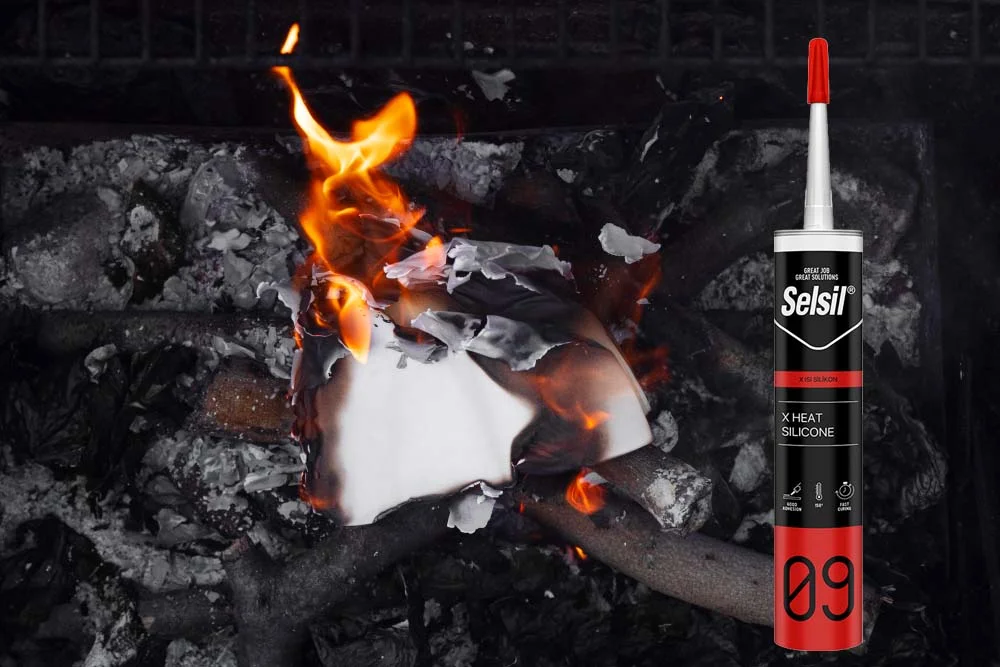
For applications exposed to heat, such as metal, engines and ovens, check the actual operating temperature and selected product’s limits. Not every standard silicone has a +150°C limit, and cured silicone does not behave by melting like hot-melt glue. Exceeding temperature limits can damage the material and adhesion. Choose heat-resistant silicone within its stated application scope. RTV means room-temperature vulcanisation; the term alone does not guarantee a particular high-temperature resistance.
Soft PVC and Flexible Materials
For soft PVC and flexible materials, assess surface compatibility, plasticiser effects and joint movement together. Do not assume every silicone is inadequate for flexible PVC. When selecting PVC adhesive or polyurethane sealant, check suitability for soft PVC and the application. Rigid-PVC pipe adhesive is not automatically an alternative for the same job.
Why does silicone sometimes detach by itself?
An unclean or weak substrate, or the wrong product, can reduce adhesion. Suitability of construction silicones for moving joints depends on the product’s movement capability; do not generalise that all construction silicones lose flexibility.
Can you apply silicone again after removing it?
Yes, but first scrape away all old silicone and clean with solvent. New silicone otherwise will not bond to the old layer.
Can silicone be painted?
No. Standard silicones do not hold paint. For a paintable surface, choose acrylic sealant.
How do you stop silicone detaching?
Make sure the surface is clean, dry and stable. The silicone must also suit the application temperature and material.