
Why Silicone Fails to Stick: 7 Common Application Mistakes
If silicone soon separates at the edges, leaks, pulls away or blisters, small application mistakes are often the cause rather than product quality. Good results need the right sequence of work rather than complicated skills. A common household repair looks neat at first, then opens at the corners a few days later. Around kitchen worktops, shower enclosures, windows and sinks, water, moisture, temperature changes and surface movement quickly expose even a small preparation error.
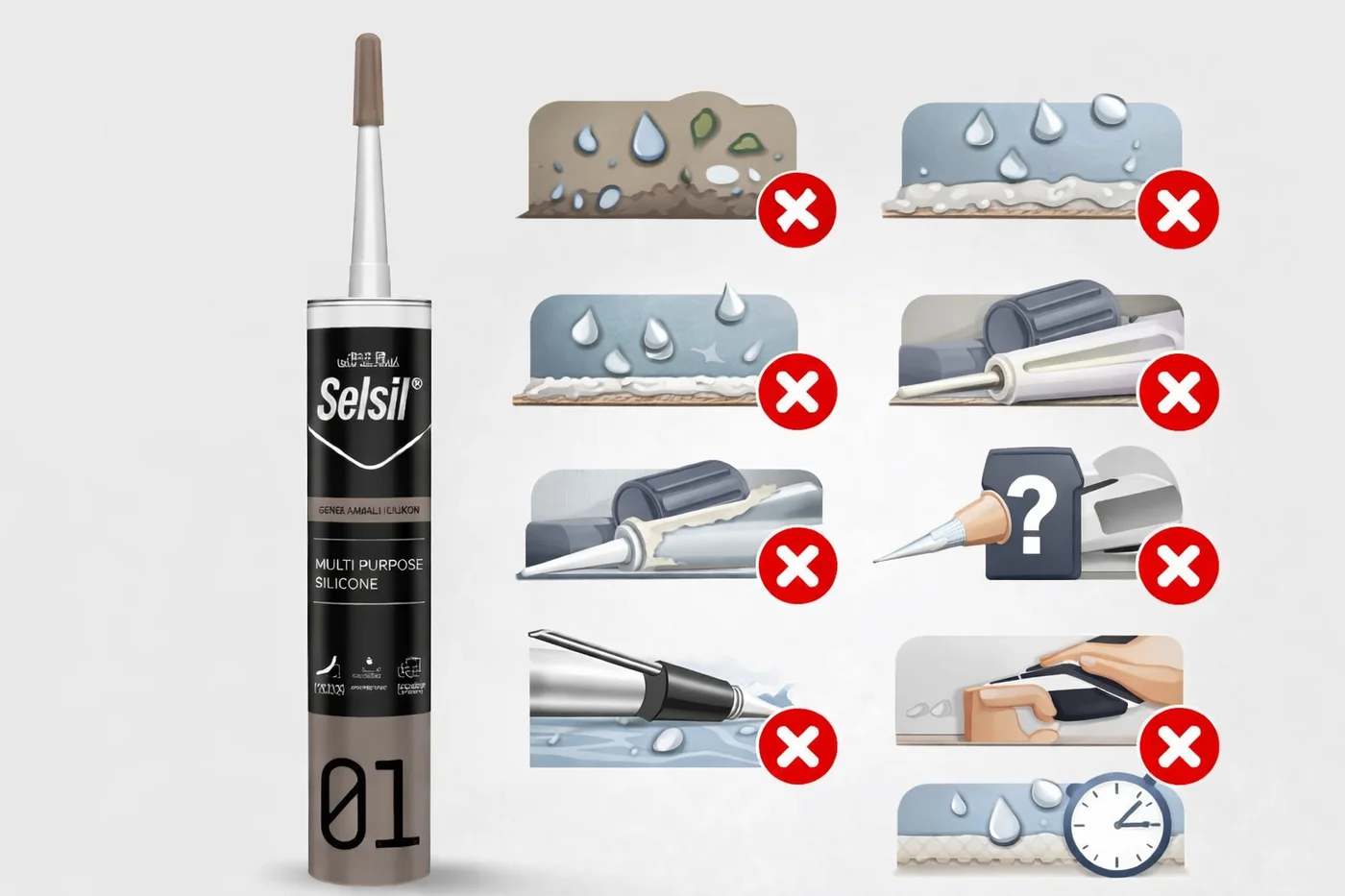
1. Applying Silicone Before Cleaning Thoroughly
A dirty surface is the most common reason silicone fails to stick. Dust, grease, detergent residue, soap film or a thin layer of limescale seriously weakens adhesion, even when invisible. The silicone sticks to the dirt rather than the surface and soon separates at the edge. This is common in kitchens and bathrooms: the area seems clean, but soap remains. Clean it thoroughly, remove greasy residue and dry completely with a cloth. This simple step is one of the main factors determining durability.
2. Applying to a Damp or Wet Surface
Water resistance can be misleading. Resisting water is different from being suitable for wet-surface application. Silicone applied straight after a shower or around a freshly wiped sink often bonds poorly. In wet areas, waiting until everything is completely dry is safest. Product choice matters even more where moisture exposure is continuous. Developed for these areas, Selsil Kitchen & Bathroom Silicone may be more suitable, with its 100% silicone polymer formulation, fungal and mould resistance, high elasticity and moisture-compatible properties.
3. Applying New Silicone Over Old Residue
Thin strips left from the previous application often seem unimportant. But without direct contact with a sound substrate, lasting use is unlikely. If the old layer is loose, mouldy, dirty or deteriorated, the new bead will eventually detach with it. Remove existing residue as completely as possible. Even tiny pieces at the edges can disrupt the new line. Extra preparation is easier than applying silicone again a few days later.
4. Using the Wrong Product in the Wrong Place
No silicone suits every area. Glass edges, shower joints, facade joints, metal frames and installation points joining different materials have different needs. Selsil General Purpose Silicone is described as a suitable option for general sealing on common surfaces such as glass and ceramics. It is a single-component, moisture-curing acetoxy product with UV and high-temperature resistance. Neutral-curing products may be more sensible around windows and frames exposed outdoors. Selsil Neutral Exterior Silicone is described as neutral-curing, low-modulus and highly elastic. For mixed materials, Selsil X1 stands out as an alternative promising strong adhesion to metal, aluminium, granite, PVC, concrete, ceramics, glass, marble, brick and wood.
5. Cutting the Nozzle Incorrectly and Losing Control of the Bead
Application thickness matters more than you might expect. Cutting the opening too wide dispenses excess silicone, spreading the bead, overflowing edges and leaving a messy finish. Too narrow, and the gap is not filled completely. Work without excessive pressure. For a neat household result, size the opening to the joint. Move the gun at a steady speed and dispense in one continuous pass. Repeated stopping and starting spoils appearance and creates weak points.
6. Overworking the Silicone During Tooling
Repeated touching to perfect the bead often causes the problem. A line that could be smoothed once becomes wavy with too much handling. Masking tape helps produce a cleaner result. One smoothing pass is usually sufficient. Repeated passes make the work harder rather than better. A practical rule for DIY work is to apply neatly once, smooth calmly and leave it alone.
7. Using the Area Before Drying Is Complete
The surface may look settled quickly, but the interior takes longer. Turning on the tap, showering, wiping the area or stressing the joint too soon can cause separation. Full performance takes time. Impatience is a common reason repairs need repeating. Silicone applied in the evening may look firm the next morning, but wait according to the product instructions for full strength. A lasting application often depends on a few hours of patience.