
Which Adhesive Should You Use to Bond Metal?
Metal can be bonded with epoxy, cyanoacrylate, polyurethane, hybrid polymer or anaerobic products, depending on the part and the load it will carry. Two-component epoxy is a more reliable choice for large, rigid joints. Cyanoacrylate suits quick repairs to small pieces. Connections exposed to vibration, impact and temperature changes are better suited to flexible polyurethane or hybrid formulations. Before choosing by product name, consider the bonding area, load direction, outdoor conditions and cure time. Structural or safety-critical parts may require welding or mechanical fastening.
Which Type of Adhesive Should You Choose for Metal?
Two-component epoxy can form a high-strength bond between steel, aluminium and other rigid materials. Mix resin and hardener in the stated ratio and apply before the working time expires. Its gap-filling ability helps when repairing pieces that do not fit precisely. For small areas needing rapid maintenance, steel-filled metal adhesive may be preferred. Starting to harden in five minutes does not mean the product can carry a full load. Wait for the final cure time on the packaging.
Cyanoacrylate fast-setting glue works on small contact areas and lightweight pieces that fit neatly together. It can be brittle in thick gaps, under continuous impact or with peel loads. Flexible, strong adhesives offer more balanced performance for outdoor sheet or profile joints exposed to vibration. Anaerobic retaining compounds can be used for cylindrical joints with narrow gaps, such as shafts, bushes and bearings. Large overlap areas carry adhesive loads in shear, increasing strength. Peel forces lifting an edge can cause early separation even with a strong product.
How Do You Prepare Metal for Bonding?
For a sound bond, remove grease, rust, paint residue and loose layers. A product applied to a greasy surface adheres to the dirt rather than the metal. After initial degreasing, lightly roughen the surface with fine sandpaper. Remove the dust, apply a suitable degreaser again and allow it to evaporate completely. Protect the prepared area as far as possible: touching it with bare hands can leave grease again.
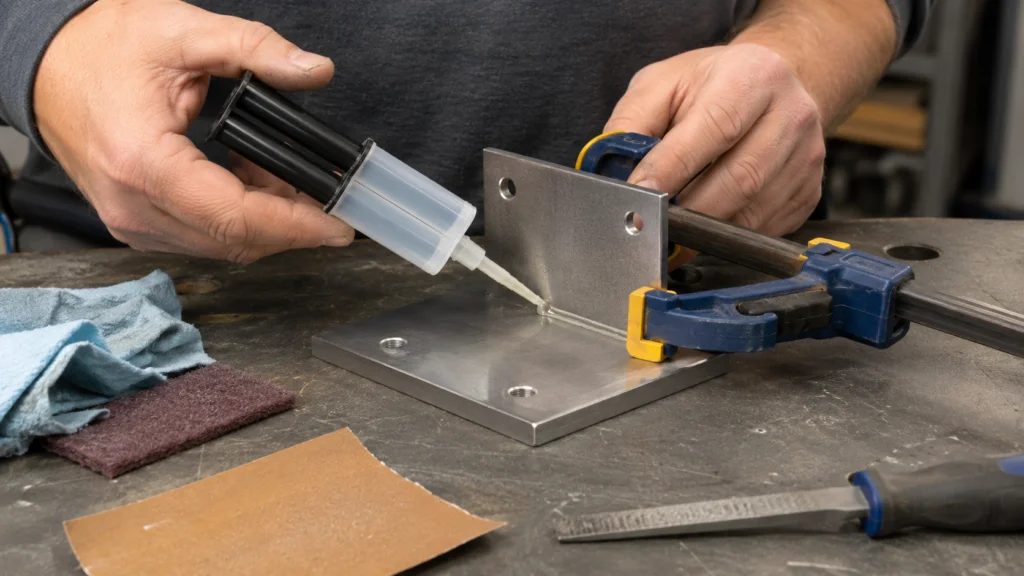
On coated parts, adhesion is to the paint or galvanised layer rather than the base metal. A weak coating can pull away with the adhesive. Testing a small, inconspicuous area gives an indication of colour changes and adhesion. Spread a thin, continuous layer of metal adhesive onto both surfaces. An unnecessarily thick layer does not always provide greater strength. Clamps or tape prevent slipping and maintain alignment during curing. When dissimilar metals such as aluminium, copper and stainless steel are joined in damp conditions, consider the risk of corrosion too.
How Do You Join Metal Parts Securely?
Dry-fit the parts first to check gaps and orientation. Then mix two-component epoxy adhesive in equal proportions, apply enough to the joint without excessive squeeze-out and secure the pieces. A low room temperature can extend curing. For work involving moisture, continuous water contact, engine heat or chemicals, follow the operating temperature, water resistance and full hardening time in the technical data sheet. Fixture time and final cure time are different. Even if the piece holds initially, do not load it too soon. Keeping the parts still during curing produces a more consistent bond line.
When repairing the fixing plate of a loose metal table leg at home, remove rust, sand the metal, apply a strong adhesive and clamp overnight. Apply load gradually the following day. Using fast-setting glue and stressing the table minutes later can cause early failure. Remove excess material before it hardens using the manufacturer’s recommended method. Wear gloves and provide air circulation indoors. Do not attempt household repairs on brakes, suspension, gas lines, load-bearing railings or high-temperature machine parts. Where welding, bolts or rivets are required, adhesive alone is not sufficient.