
Chemical Anchor Capacity: Hole Size, Depth and Cure Time
Chemical anchor capacity cannot be expressed as a single weight in kilograms. It depends on anchor diameter, hole depth, concrete class, resin, edge distance, stud quality and curing conditions. Selsil data specifies minimum pull-out loads of 7 kN for 8 mm reinforcement, 11 kN for 10 mm and 16 kN for 12 mm. These are not directly safe working loads. Project loads need engineering calculations and appropriate safety factors.
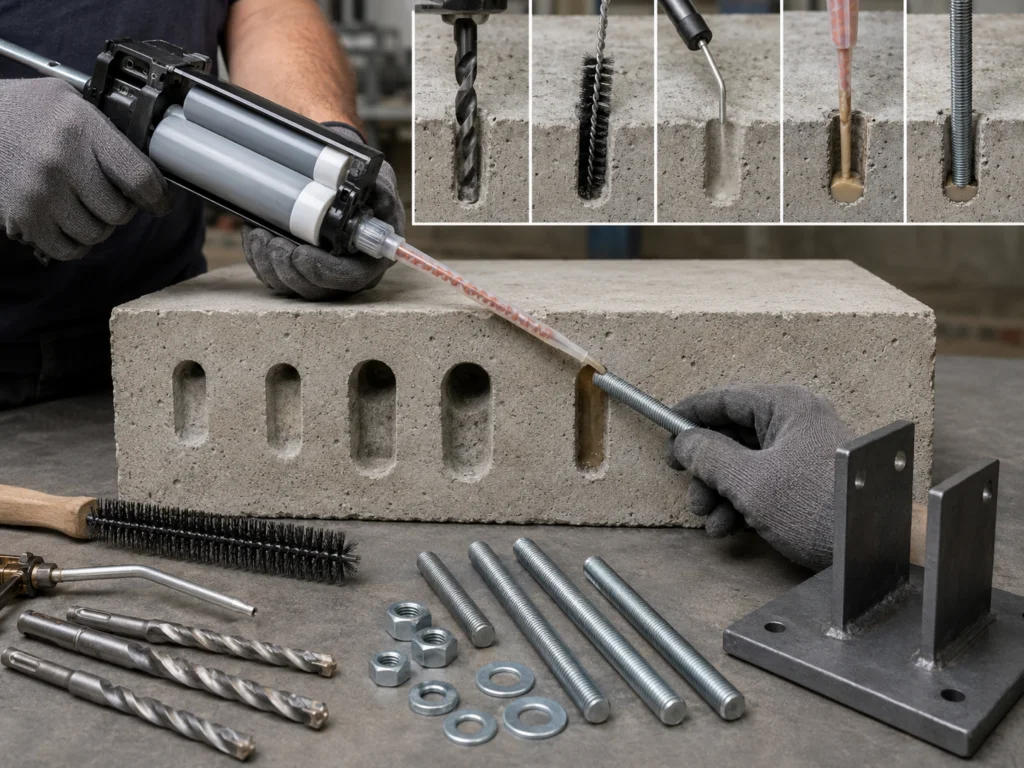
How Much Weight Can a Chemical Anchor Carry?
Capacity depends on product test values and installation conditions. For concrete, Selsil’s 300 ml epoxy and polyester products specify minimum pull-out loads of 7 kN for 8 mm reinforcement, 11 kN for 10 mm and 16 kN for 12 mm. These correspond to approximately 714, 1,122 and 1,632 kgf. Do not use them as kilogram limits for objects. Design loads and test loads are different. Handrails, steel profiles and machine feet can impose shear as well as tensile loads. Cracked concrete, edge distance, anchor spacing and embedment affect capacity. Structural connections require project calculations. Effective embedment depth and edge distance are key parameters.
What Hole Diameter Is Needed?
The hole is slightly larger than the reinforcement or rod and is determined by the product table. Selsil specifies minimum diameters of 10 mm for an 8 mm bar, 12 mm for a 10 mm bar and 14 mm for a 12 mm bar. Corresponding depths are 80, 100 and 120 mm. Oversized holes increase resin use; incorrect sizing can change the intended bond behaviour. Remove dust after drilling with a brush and suitable air method. Inject resin from the bottom and insert the stud with a slight twisting motion to the embedment level. Follow the cartridge’s technical table rather than estimating.
How Deep Should the Hole Be?
Greater depth can enlarge the connection’s working area, but does not always mean a higher safe load. Concrete thickness, edge distance, cracking, reinforcement location and product data matter. The 80, 100 and 120 mm depths for 8, 10 and 12 mm bars in Selsil’s table are specific application values. A 12 mm bar, for example, matches a 14 mm hole and 120 mm depth. If another embedment is needed, calculate it rather than increasing depth arbitrarily. Depth affects capacity alongside edge distance and spacing to neighbouring anchors.
How Long Does a Chemical Anchor Take to Cure?
Curing depends on temperature. Selsil’s 300 ml epoxy and polyester products give 2–3 hours at 5°C, 1 hour at 20°C, 30 minutes at 30°C and 25 minutes at 35°C. Working times are 25, 6, 4 and 2 minutes respectively. Product information states full curing as 7 days. Do not move the stud or load the connection before curing is complete. In cold weather, waiting only a few minutes can cause a serious installation error. Measuring temperature and following the specified time are essential for a safe joint.
How Do You Choose the Right Chemical Anchor?
Load type, substrate, stud diameter, temperature and installation conditions guide selection. Compare epoxy and polyester in the Selsil chemical anchor range. For heavy connections, compare hole sizes, pull-out loads and cure information in the technical details for Selsil Epoxy Based Chemical Anchor 300ml.
For a machine foot fixed to concrete, asking how many kilograms it carries is insufficient. Consider tension, shear, vibration, number of fixings, concrete strength and edge distance. Follow product tables for small installations. Connections involving structures or human safety require a qualified engineer to select anchors and calculate loads.