
What Is a Chemical Anchor, and How Do You Use It?
A chemical anchor uses resin to secure studs, reinforcement and fasteners in concrete, stone or suitable masonry. Unlike a mechanical anchor, it bonds to the surface and metal rather than expanding inside the hole. It can be chosen for heavy installations, handrails, metal profiles, service supports and structural connections. Hole dimensions, cleaning, mixing and curing must follow technical product information.
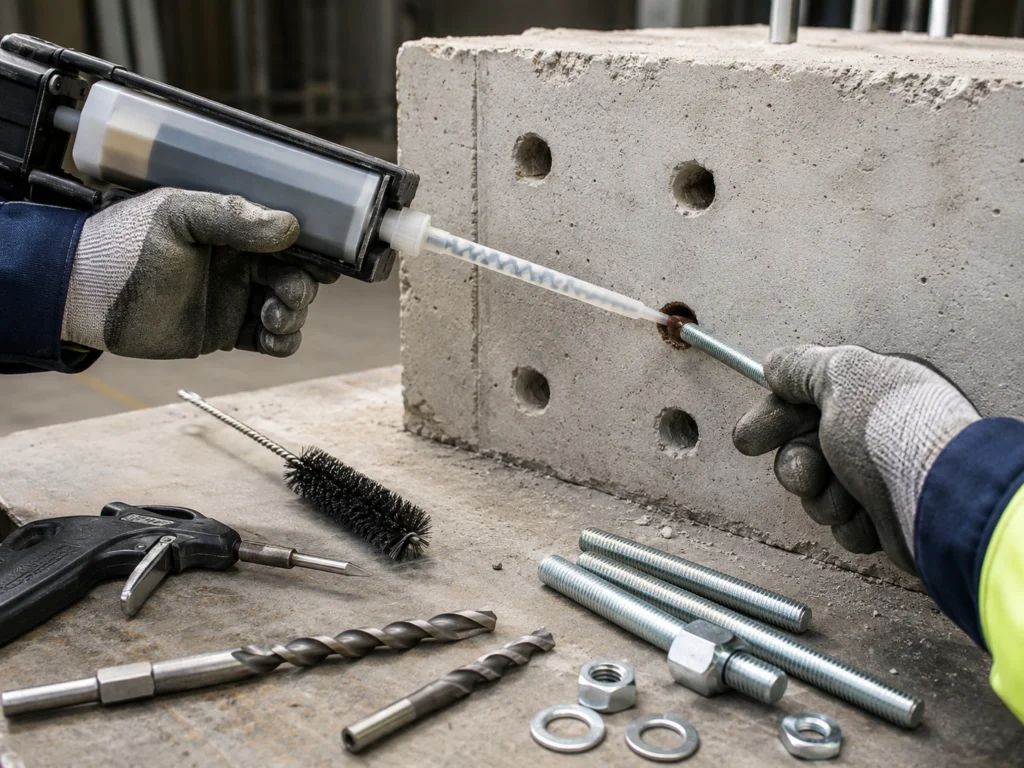
What Is a Chemical Anchor, and Where Is It Used?
The system usually consists of a two-component cartridge containing resin and hardener. They combine in a static mixing nozzle and are injected into a drilled hole. A threaded rod, stud or reinforcing bar is then inserted. Hardened resin creates a strong connection between metal and substrate.
Chemical anchors are used for heavy installations, steel structures, handrails, stairs, pipes, facade elements and post-installed reinforcement. Selsil offers epoxy and polyester options for concrete and stone. Comparing technical options in the Selsil chemical anchor range makes choosing the correct resin system easier.
How Do You Apply a Chemical Anchor?
Drill according to the stud diameter and manufacturer’s table. Depth is not chosen arbitrarily: anchor diameter, embedment, substrate and intended load all matter. Remove dust and loose material with a brush and air. Dirty holes weaken adhesion between resin and substrate.
Fit the cartridge to the gun and attach the mixing nozzle. Discard the initial material until mixing is uniform. Inject from the bottom of the hole. Insert the stud with a slight twisting motion to the intended depth. Excess resin at the opening can indicate filling. Do not move or load the part before the specified cure time has elapsed.
For a steel handrail foot on concrete, drill for the correct stud size, brush and blow the hole, inject from the bottom and twist the rod into place. Do not tighten the foot before curing finishes. Skipping a few minutes of waiting can prevent the joint reaching its calculated capacity. Even on busy sites, follow working and curing values on the label. The correct sequence significantly reduces errors.
How Are Hole Diameter and Cure Time Chosen?
Follow the system’s data. Selsil’s 300 ml tables give at least 10 mm diameter and 80 mm depth for an 8 mm bar, 12 mm and 100 mm for a 10 mm bar, and 14 mm and 120 mm for a 12 mm bar. Do not generalise these values to all products; use the relevant sheet.
Temperature directly affects curing. Selsil epoxy chemical anchor specifies 6 minutes working time and 1 hour cure at 20°C. At 5°C, curing may take 2–3 hours. Higher temperatures shorten working time, so apply promptly after preparation. Before heavy installation, check the technical values for Selsil Epoxy Based Chemical Anchor 300ml.
How Do Epoxy and Polyester Chemical Anchors Differ?
Both work similarly, but offer different resin chemistry, load classes and project suitability. Both Selsil products are two-component, apply with a sealant gun and are intended for concrete and stone anchoring.
Polyester may suit general fixing requiring rapid installation. Epoxy is commonly chosen for heavy loads and structural connections. Do not decide by product name alone. Substrate, cracking, stud diameter, edge distance, embedment, temperature and calculated load are decisive. Hollow substrates such as perforated brick may generally need a suitable sleeve or mesh sleeve. The safest approach is to follow manufacturer dimensions and engineering calculations.